
Loading
3366 Members
 Join Permit's Slack
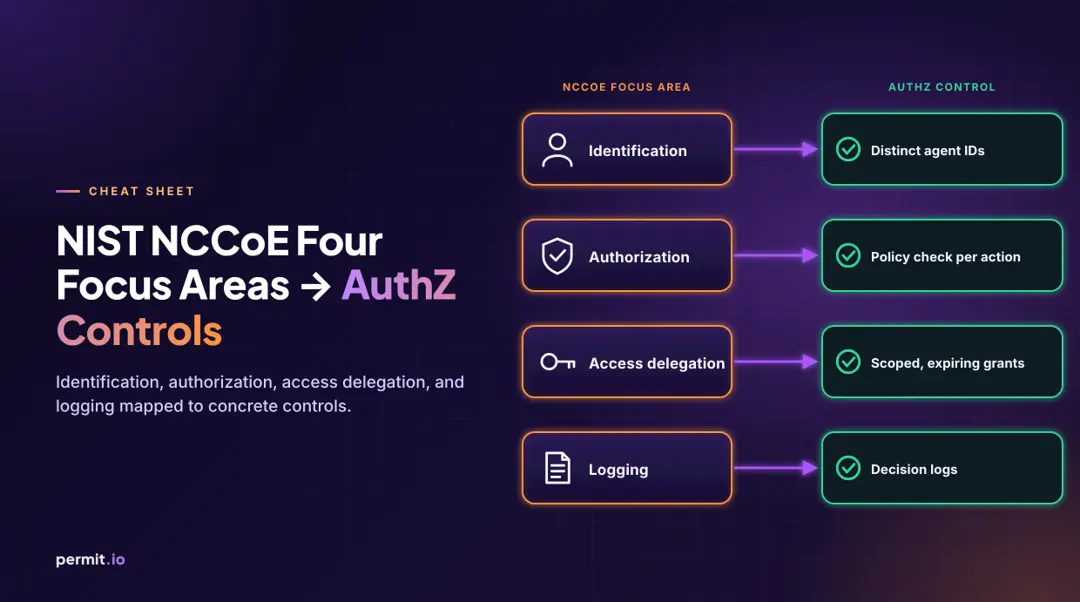
Quick answer: NIST NCCoE's concept paper on AI agent identity and authorization names four areas of interest: identification, authorization, access delegation, and logging. Use this cheat-sheet to map each area to a concrete authorization control in design reviews. Don't treat it as a standard or certification checklist: the paper is a concept document seeking input, not final guidance.
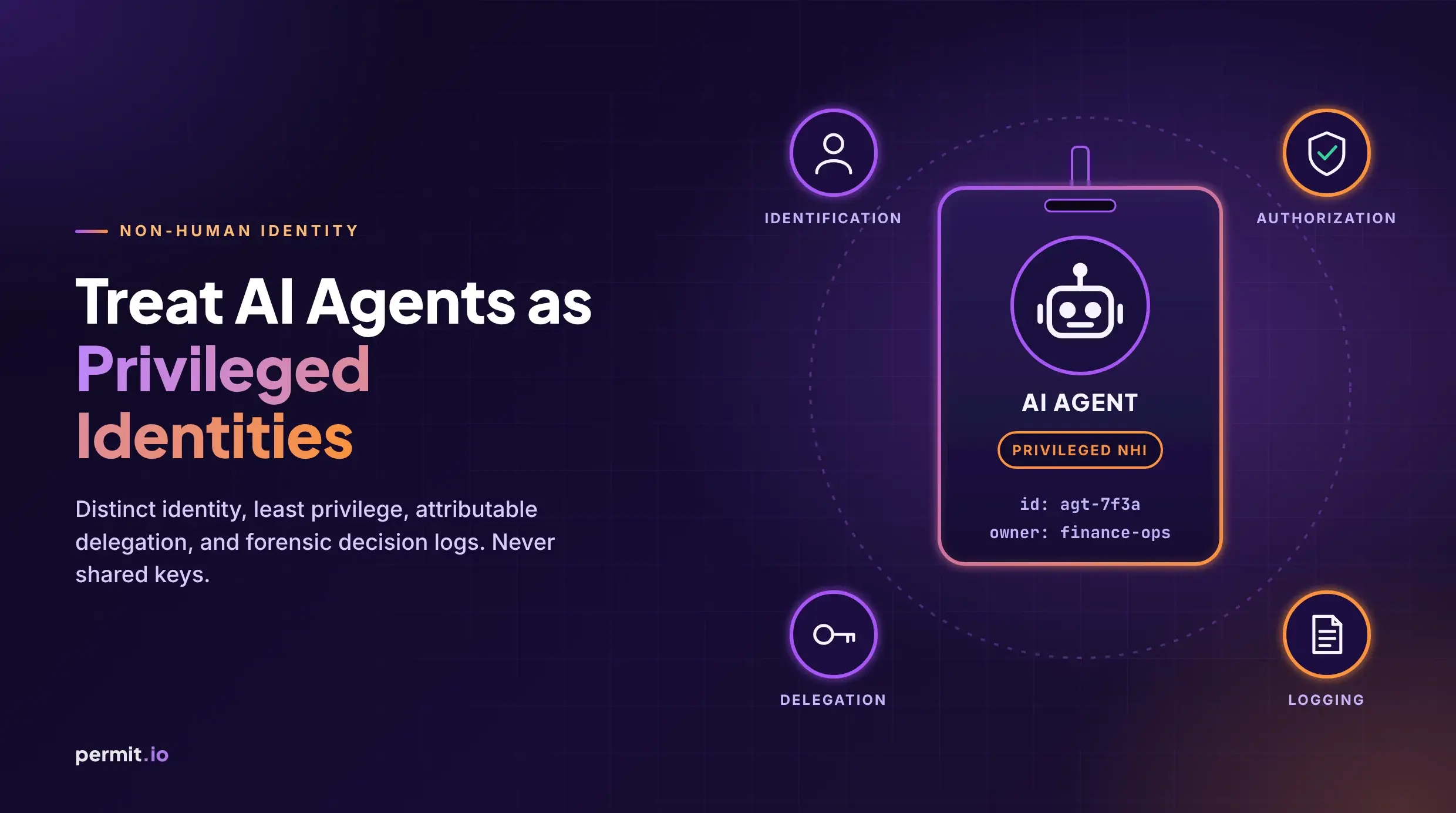
NIST NCCoE's concept work on software and AI agent identity and authorization explores four focus areas: identification, authorization, access delegation, and logging. A practical AuthZ map is: distinct agent identity, policy-based least privilege, attributable human→agent grants, and forensic decision logs. Use this as an alignment aid for design reviews, not as a certification checklist.
| Focus area | NCCoE intent (plain language) | Concrete AuthZ control |
|---|---|---|
| Identification | Know which software or AI agent is acting, not just which user triggered it. Agent identity should be separate from the human identity, with metadata describing its action range and autonomy level. | Create a distinct agent / non-human identity (NHI) for every agent, workflow, service, or MCP-connected runtime. Attach attributes such as owner, tenant, approved tools, autonomy level, runtime, and environment. |
| Authorization | Ensure agents can only perform actions they are entitled to perform, on the specific tools, resources, tenants, and data they are allowed to touch. | Use policy-based entitlements and least privilege at the per-tool, per-resource, and per-tenant level. Define trust ceilings so an agent can have narrower rights than the human who delegated work to it. |
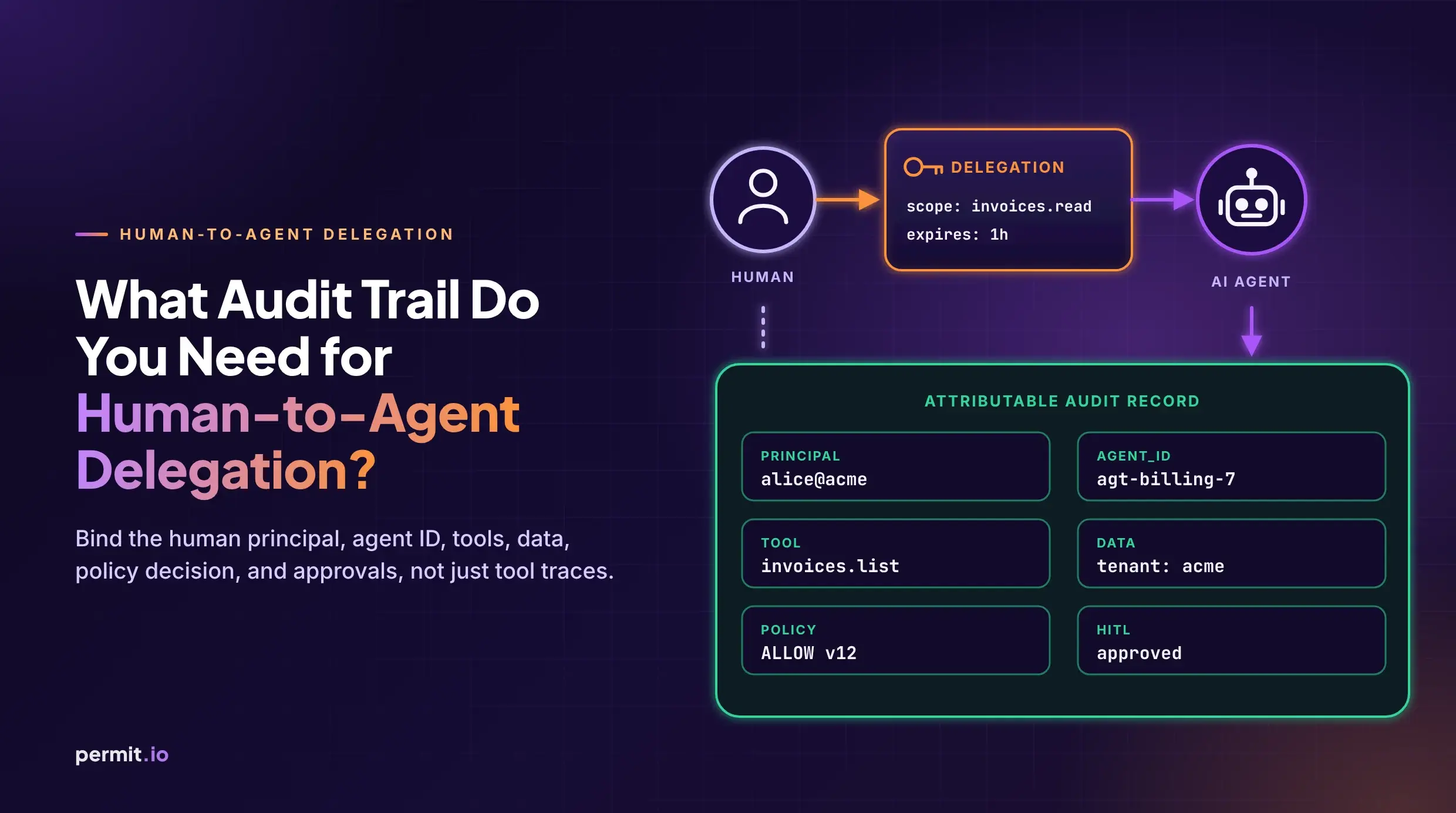
| Access delegation | Make delegation explicit when a human allows an agent to act on their behalf. The relationship should be scoped, revocable, and accountable. | Model a clear human→agent grant. Include scope, duration, resource boundaries, allowed actions, approval path, and revocation. Do not collapse the human and agent into one identity. |
| Logging and transparency | Be able to explain what happened: which agent acted, who delegated or initiated it, what tool was used, what resource was touched, and why the decision was allowed or denied. | Produce decision logs attributed to the non-human entity, human principal, tool, resource, action, tenant, allow/deny result, policy reason, and any human-in-the-loop (HITL) checkpoint. |
The shift is simple: agents are not just API clients. They are delegated actors with tool access, changing context, and sometimes partial autonomy. That makes authorization design more important, not less.
In a traditional app, you might ask: "Can Alice edit invoice 123?"
In an agentic app, the question becomes: "Can Agent X, acting under Alice's delegated grant, use Tool Y to edit invoice 123 in Tenant Z, given its autonomy level and approval state?"
That is a fine-grained authorization problem.
Use this map as an engineering lens for agent deployments. It is directionally aligned with NCCoE's concept work, but it is not a statement that "NIST requires these exact controls." Implementing these patterns also does not make a system NIST-certified, NCCoE-certified, or automatically compliant with any framework.
For reference, this is how the NCCoE concept paper words its authorization area of interest:
Authorization of AI Systems. Leveraging standards such as OAuth 2.0 and its extensions and policy-based access control mechanisms, to manage how rights and entitlements are granted to software and AI agents and to enforce access decisions based on the identity of the AI agent or software systems.
The table above translates each of the paper's areas into plain-language intent and a concrete control. The paper is a concept document seeking input, not final guidance.
The practical use is design review. Before an agent reaches production, ask:
Pair this with the AuthZ pillars you already need in modern applications: enforcement at the point of action, granularity over tenant/resource/relationship/action/agent attributes, realtime propagation of revocations and approvals, and audit logs security teams can use.
This is especially important for MCP and tool-calling paths. If an agent can invoke tools that read tickets, update CRM records, query production data, or trigger workflows, then "the model decided to call the tool" is not an authorization boundary. The application still needs an explicit policy decision before the tool executes.
For the broader argument, see the companion pillar: /blog/agents-as-privileged-identities. Related: /blog/ai-era-same-bar-higher-bar, /blog/human-agent-delegation-audit-trail, and /blog/dora-nist-access-control.
Use these as engineering evidence questions, not as regulator attestation:
If the answer is "no" to several of these, the issue is usually not that the system uses AI. The issue is that the agent is operating like a privileged identity without the controls we already expect for privileged access.
Four focus areas map to four AuthZ habits:
That is the bar I'd use for production agent systems. Treat agents as privileged identities, extend your fine-grained authorization model to cover them, and make decision logs part of the control plane.
If you are building MCP-based paths, start with the Permit MCP Gateway docs: https://docs.permit.io/permit-mcp-gateway/.
This mapping is an engineering alignment aid. It does not guarantee compliance, certification, or acceptance by any regulator or standards body.

Co-Founder / CEO at Permit.io