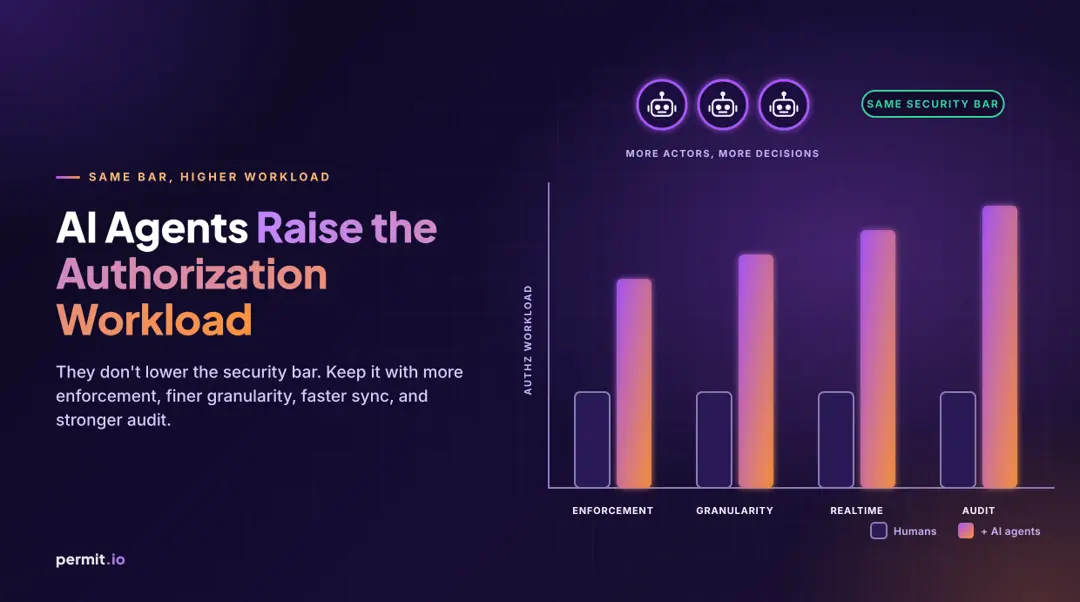
Quick answer: AI agents do not lower the security bar. They multiply the places where authorization must run. Delegation becomes part of the authorization shape: the delegating human, the agent, the scope delegated, the resource, and the conditions. Extend your existing fine-grained authorization with per-action checks, trust ceilings, and decision logs that capture the human, the agent, the delegation, the policy, and the reason.
OAuth alone is not an agent authorization system. OAuth establishes delegated access to APIs and resources, but it does not authorize each tool action, bind that action to verified intent, or stop a hijacked agent from abusing permissions the user already granted. Authentication gets you a principal. Agents still need action-time authorization for every side effect.
Related reading: Machine Identity Security: Managing Risk, Delegation, and Cascading Trust, Best Practices for Effective User Permissions and Access Delegation, Human in the Loop for AI Agents.
What actually changed
The security problem did not become magic because the interface became conversational. What changed is the shape, speed, and volume of actions.
In a normal application flow, a human clicks through a UI. The app enforces authorization at sensitive actions: view a customer record, approve a refund, export a report, deploy to production. Identity, tenant, role, attributes, and relationships are evaluated by the application or by an authorization service.
With agents, one prompt can trigger a chain: interpret the request, build a plan, select tools, read data, transform it, call another tool, and create a side effect in a production system. That does not remove authorization. It multiplies where authorization has to happen.
Several shifts matter:
- Non-human identities: agents, MCP clients, workflow runners, and service accounts operate at machine speed. One human prompt can generate dozens of tool calls. Broad credentials amplify blast radius.
- MCP and tool brokers: useful standardization, and a new routing layer between a reasoning system and production capabilities. That layer needs policy enforcement, or the agent's access is whatever the MCP server, API key, or downstream account allows.
- Multi-step, probabilistic actions: the agent may search and summarize before calling a tool that creates the side effect. A check at session start is not enough. Authorization has to operate across plan, tool call, and side effect.
- Implicit vs explicit authority: "the agent is logged in as me, so it can do what I can do" is not a production model. Delegation needs to be explicit, scoped, revocable, and attributable.
- Volume: one session can touch CRM, ticketing, infrastructure, source code, knowledge bases, billing, and customer data. Unchecked tool calls create an authorization blind spot exactly where automation accelerates.
No AGI speculation is required. This is production security under higher load.
Delegation is the new authorization shape
Traditional access control asks: can this principal perform this action on this resource? Agent authorization extends the question. You need to know who delegated authority to the agent, what scope was granted, what resource is targeted, and under what conditions.
The authorization shape becomes:
can(delegator, agent, scope, action, resource, conditions)?
The delegator is the human who authorized the agent to act. The agent is the software principal performing the action. The scope is what the human consented to (read, write, delete, specific tools). The resource is the target. Conditions include time, tenant, workflow, trust level, and whether human approval is required for this action.
This matters because agents rarely act in isolation. An AI assistant fetches data for a user. A service triggers a downstream action in another system. An agent calls another agent. The delegation chain can span multiple layers.
Without clear delegation boundaries, you cannot answer basic questions: Who initiated the action? Which agent is carrying it out? Is that action actually authorized? The result is unauthorized access, where agents perform tasks or reach data far beyond what the original human intended, because the delegation chain was never enforced or auditable.
The gap shows up in production. A user grants an agent access to their email for scheduling. The agent's underlying permissions also allow it to send emails externally, purchase items, or access files. The user consented to scheduling. The agent can do much more. That gap between consented scope and actual capability is the delegation failure.
Zero trust, zero standing credentials for agents
Agents should never hold your upstream credentials. They should never act as the human directly. The principle is zero standing privileges: agents receive scoped, short-lived tokens tied to a verified delegation, and those tokens can be revoked independently of the human's access.
The alternative is the Muse failure pattern. Meta Muse reportedly held standing grants across mail, calendar, purchasing, WhatsApp, local files, microphone, camera, and location. An unprivileged local process could hijack the agent's session and abuse already-granted privileges. This is access amplification. Standing god-mode with a friendly UX is not least privilege.
A production model separates three things:
- The human's identity: verified through your IdP (SSO, OIDC, OAuth).
- The agent's identity: a distinct principal, fingerprinted and tracked.
- The delegation grant: explicit scope, issued at consent, revocable by the human or admin, attributable in logs.
The agent receives a representative token. The real upstream credentials stay vaulted. Revoke the human's access, change their role, or withdraw consent, and the agent loses access on its next call.
This is not theoretical. It is how you keep agent sessions from becoming permanent backdoors when a human changes teams, leaves the organization, or revokes consent.
In-session drift: why session-start checks fail
A single authorization check at session start is not enough. Agents drift.
Drift can happen for several reasons. A prompt injection changes the agent's behavior. A model swap changes its capabilities. The user keeps prompting the agent into territory they did not originally intend. The agent's context window fills with new instructions that shift its goals.
Suppose a user starts a session asking the agent to summarize invoices. Halfway through, the agent, prompted by the user or by injected content, starts purchasing gift cards. The original consent was for read access to invoices. The action is a write to a payment system. A session-start check does not catch this. Per-action authorization does.
Per-action checks re-evaluate the delegation, the tool, the resource, and the conditions on every side-effecting call. Drift detection compares the agent's declared intent (at session start) against its current behavior. If the fingerprint diverges, you deny the call, require re-consent, or insert human approval.
This is the difference between "the agent authenticated and got a token" and "this specific tool call is allowed right now, for this actor, intent, resource, and context."
Agent interrogation and the judge agent
Before powerful tools unlock, force the agent to identify itself. This is the identify_self handshake.
The agent declares:
- Identity or fingerprint: which agent, client, or runtime is calling.
- Delegator or composite identity: who the agent acts for, and how the user and agent identities compose.
- Intent or purpose: what this session is trying to accomplish.
Declared intent is an input, not trusted merely because the agent stated it. Check it against identity, tool choice, arguments, session behavior, and human consent before unlocking capability. Only then expose a policy-gated tool catalog for that agent, delegator, intent, tenant, trust level, and context.
Re-check every tool call. Agents drift. Prompts get injected. Local processes get compromised. Fingerprinting and drift monitoring catch when "summarize my invoices" becomes "purchase gift cards."
The concept of a judge agent or guardian agent extends this pattern. Gartner describes guardian agents as AI-based technologies that monitor other AI agents and can redirect or block their actions. The judge agent observes every action, compares it against policy and declared intent, and adjusts trust levels or blocks calls that diverge. This is runtime governance: monitor, adjust, enforce.
At the enforcement layer, this means the judge agent (or the gateway acting as one) can downgrade trust, require re-consent, or deny a call when behavior drifts from the fingerprint baseline.
Decision logs that answer "why was this allowed"
Audit is not optional. If you cannot explain why an agent was allowed to perform an action, you have a blind spot.
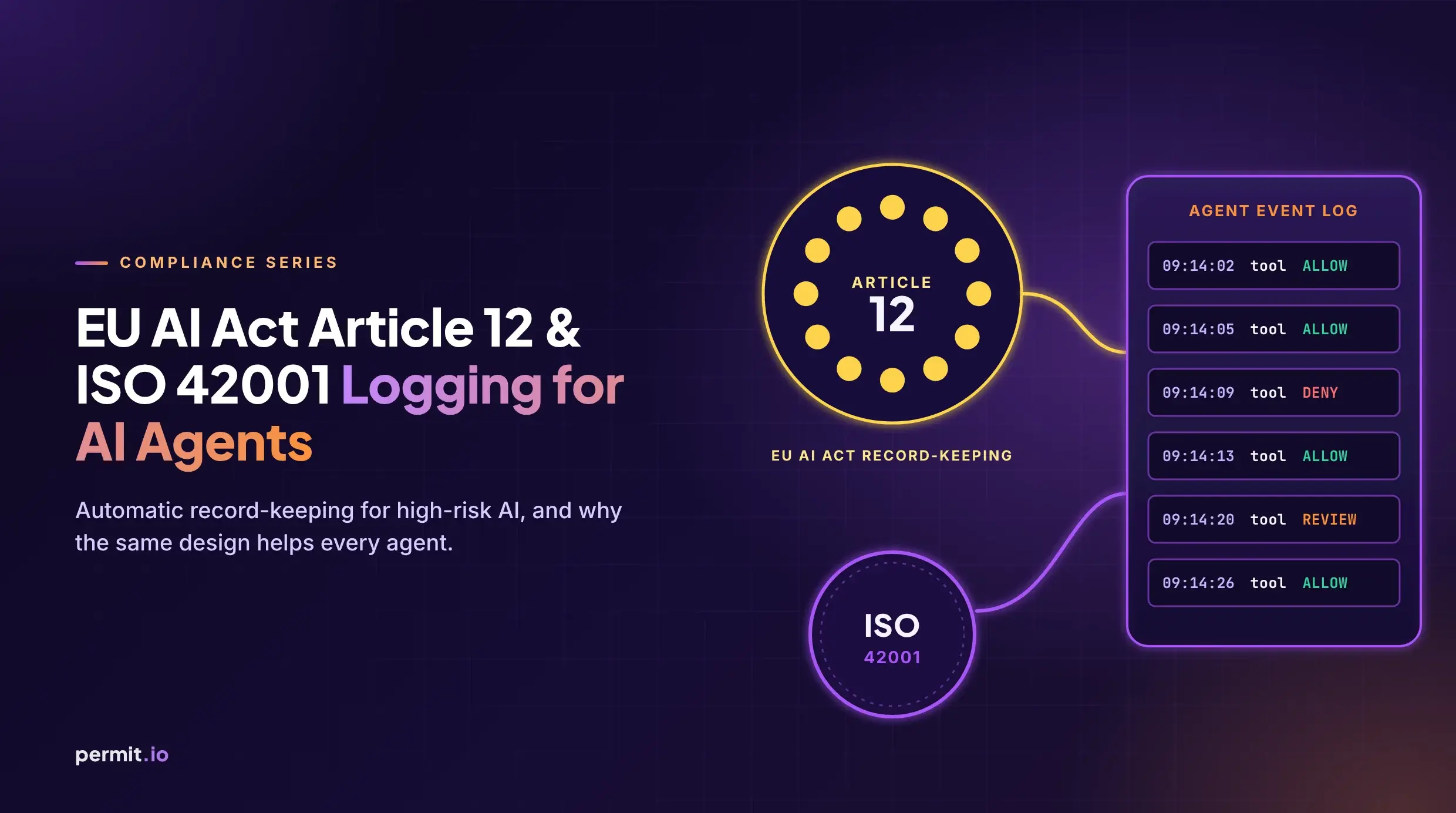
A useful decision log captures the full chain:
- Human principal: who delegated access.
- Agent instance: which agent acted.
- Delegation grant: what scope was consented to.
- Tool and resource: what was attempted.
- Action: read, write, delete, or custom.
- Decision: allow or deny.
- Policy reason: which rule matched and why.
- Human-in-the-loop: if approval was required, was it completed.
Tool traces help debugging. They are not enough for authorization evidence. A trace may show that a tool was called. It may not show whether policy allowed it, which rule matched, whether the agent was acting under human delegation, or whether an approval obligation was satisfied.
This kind of log answers the questions auditors and incident responders will ask: Who authorized this agent? What scope did they grant? Why was this action allowed? Was human approval required? Did the agent's behavior match its declared intent?
Without this, agent activity becomes untraceable. You cannot spot abuse, track incidents, or prove compliance.
What "same bar" looks like in practice
The four pillars of production authorization have not changed: enforcement, granularity, realtime, and audit. Agents put them under more load. Here is what keeping the same bar requires.
Distinct agent identity and human delegation. Policy and logs should distinguish human principal, agent instance, workflow, tool, tenant, and resource. Avoid anonymous automation and shared credentials. A good decision log answers: Alice delegated ticket triage to Agent-123. Agent-123 attempted to read Ticket-456 in Tenant-789. The request was allowed because Alice is assigned to that tenant and the agent grant allows read-only ticket access.
Least privilege per tool, resource, and data class. Do not grant "all tools" unless you would grant "all APIs." Scope by tool, action, resource, tenant, data class, workflow, time window, and trust level. Trust ceilings are useful: a user may have broad admin rights while the agent is capped at read-only, one tenant, or blocked from regulated data unless a human approves.
Runtime checks on every sensitive tool call. The enforcement point sits in the runtime path: middleware, API gateway, MCP gateway, or tool broker. A prompt is not a permission boundary. A system instruction is not a permission boundary. The tool call needs a real policy decision.
Fast revoke for sessions and delegation grants. Revoke human access, agent identity, human-to-agent delegation, tool grants, relationships, and emergency access, and push those changes to enforcement points quickly. Policy changes should apply on the next tool call, not after a restart or a deploy.
Decision logs that explain allow and deny. For agent authorization, logs should answer who the human was, which agent acted, which tool and resource were involved, allow or deny, which policy explains the decision, and whether human approval was required and completed.
Agent interrogation before tools unlock. The agent identifies itself, declares its delegator and intent, and receives only the tools its trust level allows. Drift from the fingerprint triggers re-consent or denial.
Put enforcement in front of MCP servers. Identify the client and agent, resolve the human delegator, evaluate policy before tool calls, enforce scopes, apply human approval for high-risk actions, log the decision, and pass only authorized calls downstream. The Permit MCP Gateway does this: authentication, fine-grained authorization, consent, and audit in front of MCP servers without rewriting every tool. Each tool call is checked with Permit before it reaches the MCP server. The gateway assigns trust levels (low, medium, high) based on tool risk, and an agent with medium trust can call low and medium tools but not high-trust tools like delete operations. Trust ceilings enforce that an agent cannot exceed the level the human granted, and the human cannot grant more than the admin's maximum.
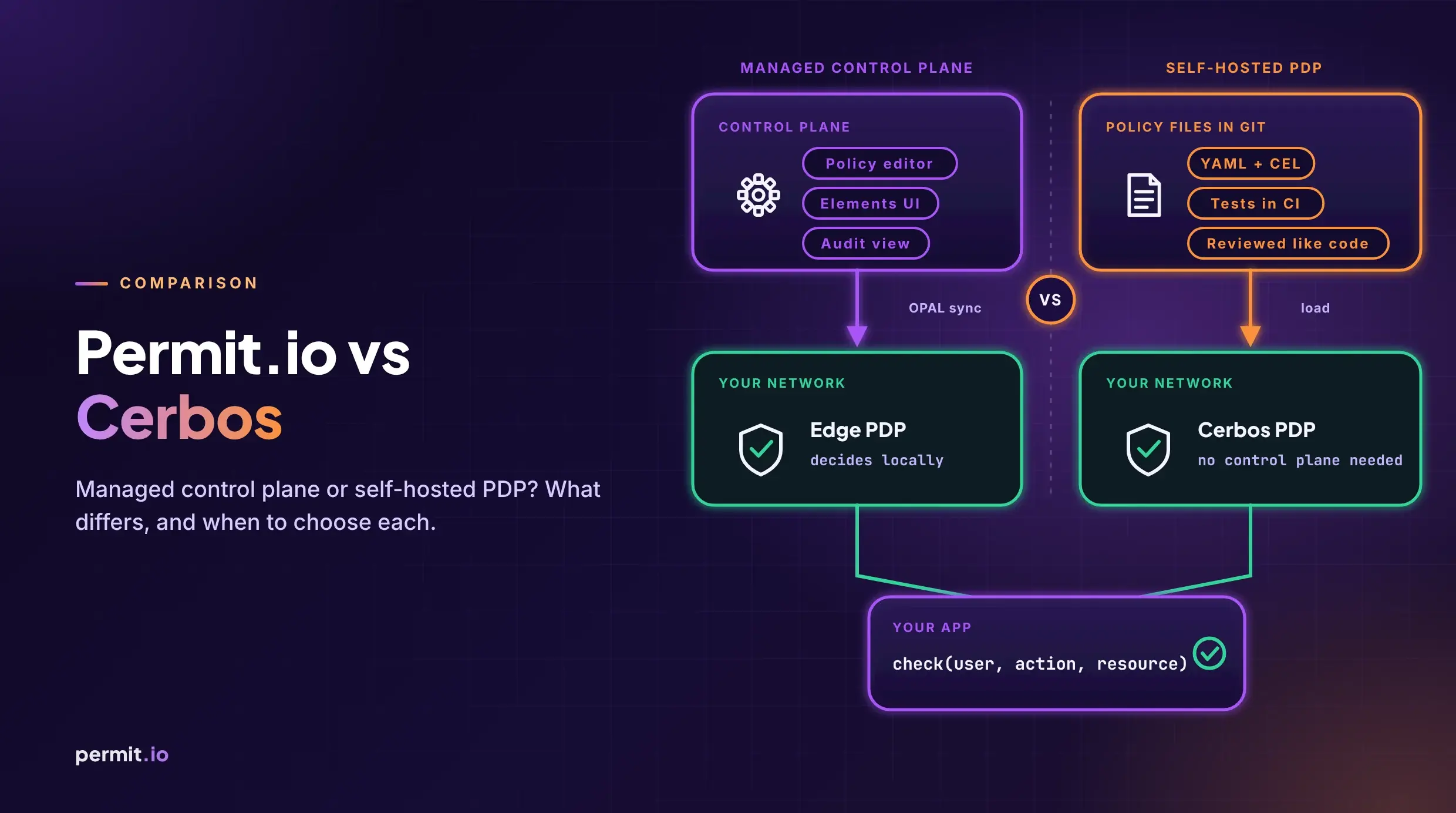
Permit's hybrid architecture decouples the control plane from the data plane. Keep enforcement close to your workloads. OPAL pushes policy and authorization data updates in realtime. A change to a trust level, access grant, or revocation applies on the next tool call. See how Permit works and the control plane / data plane split.
Soft close
Agents raise the authorization workload. They do not create a lower bar, and they do not justify weaker controls.
Delegation is now part of the authorization shape. The human, the agent, the scope, the resource, the conditions. Authorization has to answer for all of them. Zero standing credentials for agents. Per-action checks that catch drift. Decision logs that explain the full chain.
Extend fine-grained authorization: more enforcement points, finer granularity, faster realtime sync and revoke, and stronger attributable audit. Those are the same four pillars production applications already need. Agents and MCP tools simply put them under more load.
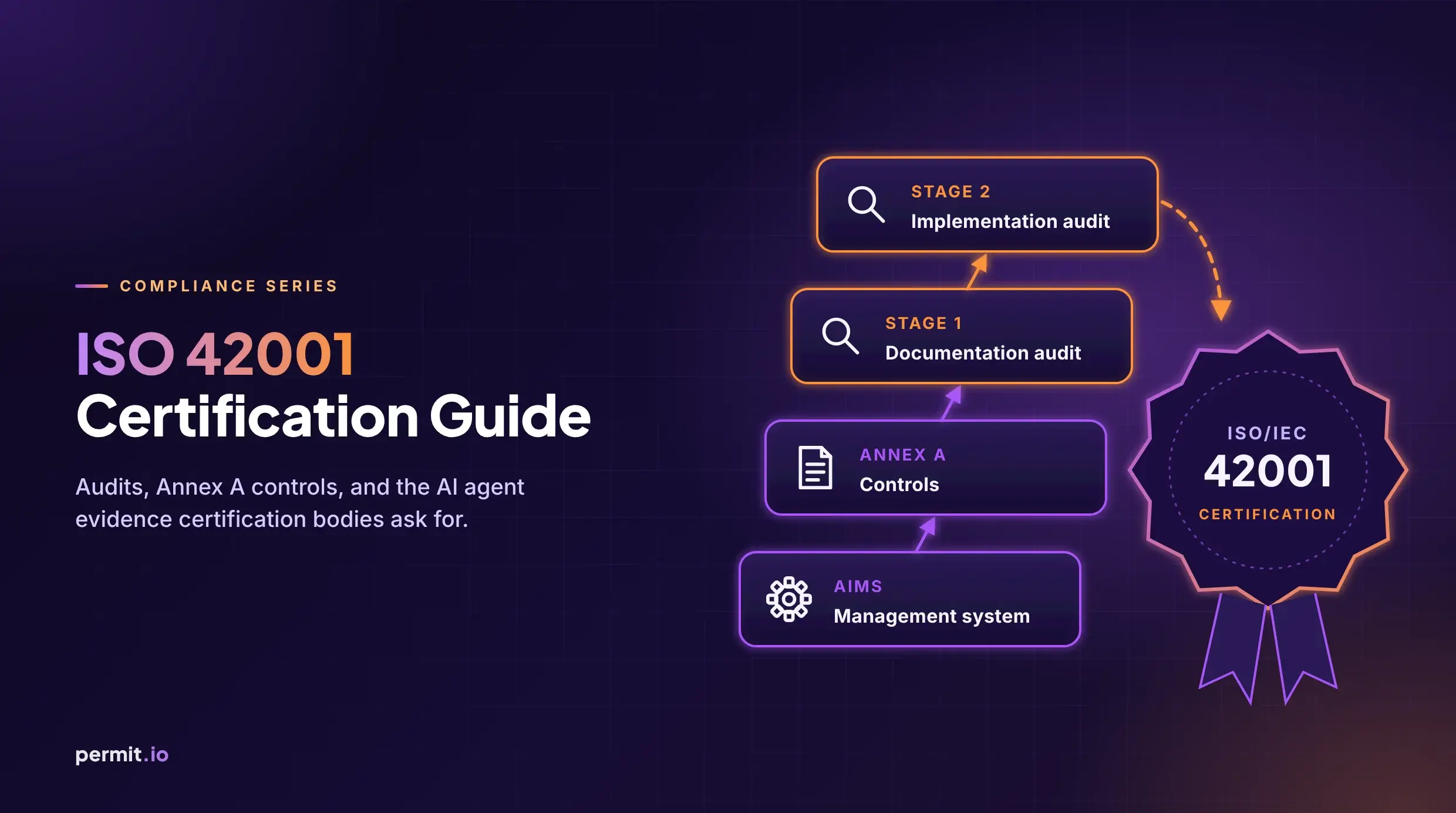
That discipline does not guarantee regulatory compliance or certification. But it prevents agents from becoming an access-control blind spot, and gives security, engineering, and compliance teams a concrete way to keep the same bar while shipping the next interface.