

Loading
3366 Members
 Join Permit's Slack
Quick answer: An AI agent audit log is the authorization record written each time an agent attempts an action: who or what acted, for whom, on which resource, under which policy, with what outcome. Use it when agents call tools, change data, or act for users and you must reconstruct what happened. Skip the full twelve-field schema for read-only assistants that touch no tools or sensitive data.
AI agent audit logs are how you prove what an agent was allowed to do. OAuth alone is not an agent authorization system. If an AI agent can call tools, mutate data, open tickets, issue refunds, change configurations, or send messages, auditors will need evidence of more than "a token existed."
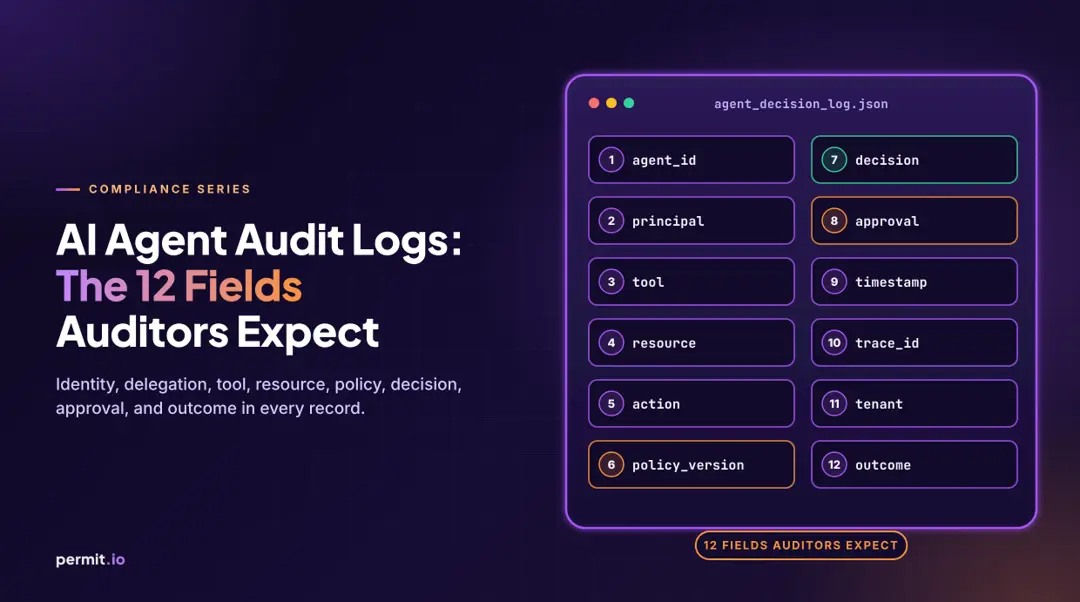
Answer first: the core AI agent audit log (the authorization record emitted at decision time) should capture approximately these twelve fields:
Auditors care because agent actions often sit between identity, application logic, APIs, data stores, and third-party tools. A good AI agent audit log lets a reviewer reconstruct who or what acted, under whose authority, against which resource, according to which policy, and what actually happened afterward.
This is an engineering evidence pattern, not a certification checklist. Your auditor, assessor, legal team, and control owners will decide what evidence is sufficient for your program. The goal here is practical: make agent authorization explainable before an incident, audit, or customer security review forces you to reverse-engineer it.
For a primary-source baseline, NIST's security and privacy control catalog describes what audit records should establish (control AU-3, Content of Audit Records):
Ensure that audit records contain information that establishes the following: a. What type of event occurred; b. When the event occurred; c. Where the event occurred; d. Source of the event; e. Outcome of the event; and f. Identity of any individuals, subjects, or objects/entities associated with the event.
Source: NIST SP 800-53 Rev. 5, AU-3 Content of Audit Records
The twelve fields below extend that baseline with agent-specific context: delegation, tool parameters, policy version, and approvals.
Traditional identity provider logs are necessary, but incomplete. They usually tell you that a user authenticated, an application received a token, a session was created, or a scope was granted. That does not prove that a specific agent action was authorized in context.
Application logs are also necessary, but often too late in the flow. They may record that an API endpoint was called or that a database row changed. They do not always show the authorization decision that preceded the action, the policy version evaluated, or whether a human approval was required.
Agent systems make this harder because the actor is not always a human clicking a button. An agent may plan several steps, choose a tool, pass parameters, call an API, and produce a side effect. It may act on behalf of a user, a team, a tenant, a workflow, or another service. That means the evidence has to capture delegation, policy context, and action outcome in one correlated trail.
This is why "why was this allowed?" becomes a first-class security question. I wrote about that more generally in Why Was This Allowed? Authorization Logs, and about the inverse audit problem in SOC 2 and the Explainable Deny. Agent logs need the same discipline, with more attention to delegation and tool execution.
The log should identify the agent that attempted the action, for example agent_support_bot_01 or agent_finance_reconciler. Auditors need to distinguish between a human user, a service account, a workflow, and an AI agent because each may have different control requirements.
If this field is missing, the evidence collapses into a generic API call. You may know that "something" accessed a tool, but not which agent behavior, prompt flow, or runtime was responsible.
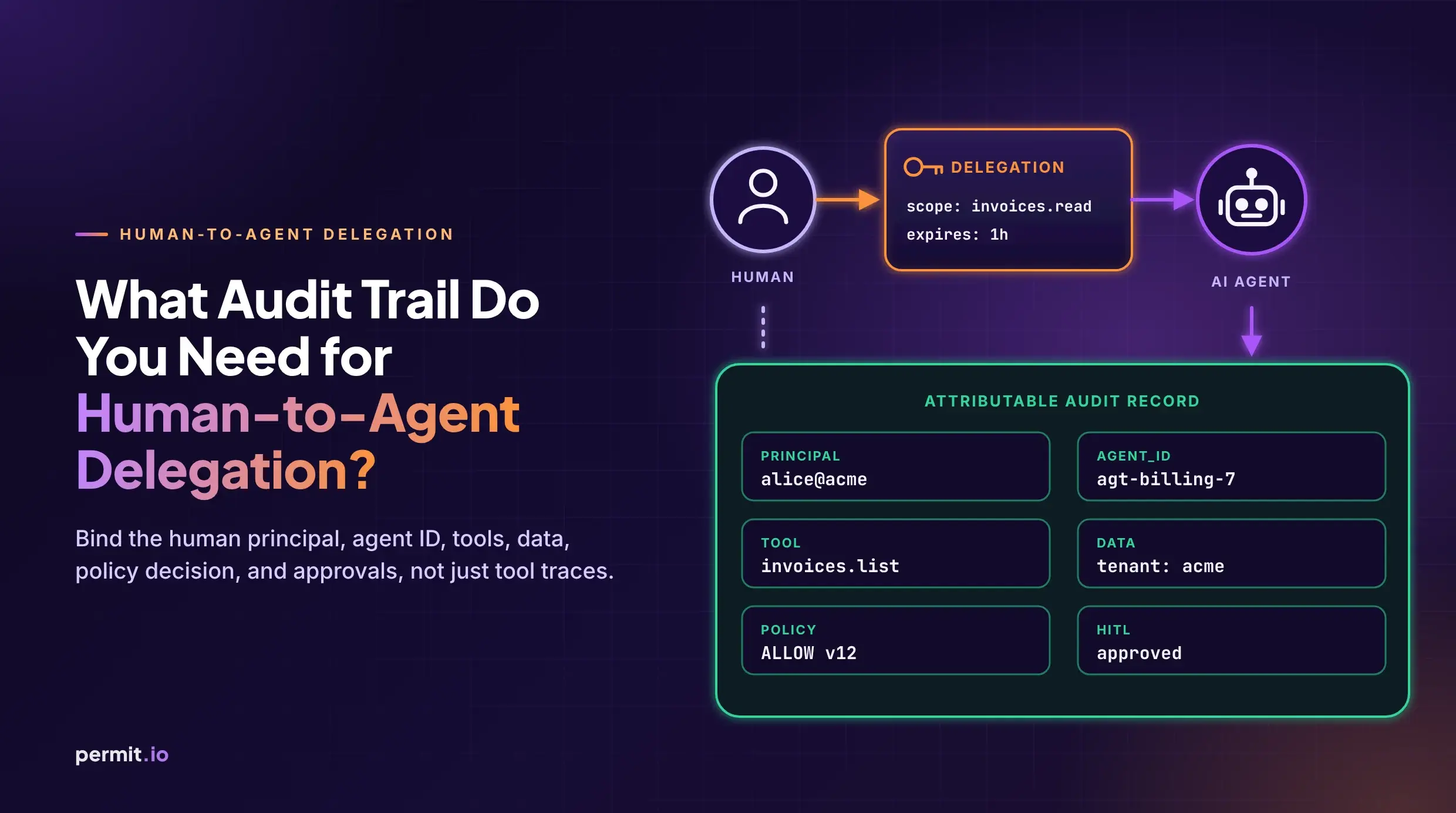
Most agent actions should be tied back to a human principal or an explicit delegation chain. This might be the user who initiated the chat, the manager who approved a workflow, or the service identity that delegated authority to the agent.
Auditors care because accountability depends on provenance. If an agent refunds a customer, changes a policy, or exports data, the reviewer will ask whose authority was used. Without this field, you risk treating autonomous execution as if it were fully authorized just because the agent had credentials.
The log should capture the tool the agent attempted to use and the material parameters passed to that tool. For example, crm.update_ticket with ticket_id, status, and customer_id.
This matters because agent risk is often in the tool call, not the natural language response. "Summarize account history" and "email account history to an external address" are very different actions. If the tool and parameters are missing, an auditor cannot determine the real operation that was attempted.
The resource is the object the agent tried to access or modify. It could be a ticket, invoice, patient record, repository, environment, tenant, customer account, or document.
Auditors need resource-level evidence because broad statements like "the agent used the billing tool" are not enough. Access controls are usually meaningful at the resource boundary. Without the resource, you cannot prove whether the agent touched the correct customer, tenant, system, or data classification.
The action describes what the agent intended to do to the resource, such as read, update, delete, approve, export, refund, or send_message. It should be explicit and normalized enough to support review.
This field matters because the same resource may be safe to read but dangerous to modify. Auditors will often test whether your authorization model separates duties by action. If the action is missing or vague, every review becomes a forensic exercise.
A useful decision log records the policy that was evaluated, including a stable policy ID and version. For example, support_ticket_access:v2025.02.18.
Auditors care about policy versioning because authorization is not just a runtime event. It is also a change management question. If you cannot identify the policy version used at decision time, you may not be able to prove whether the decision followed the approved control in place then.
The decision should be explicit: allow or deny. The reason should explain the relevant policy outcome in human-readable terms, such as "allowed because requester is assigned support engineer for tenant" or "denied because export requires manager approval."
This is the core of explainable authorization. Auditors do not want to infer decisions from downstream success or failure. If the reason is missing, you might know what happened, but not why the control allowed or blocked it.
Some agent actions need approval before execution. The log should capture whether approval was required, the approval ID, the approver (who approved or rejected), the approval timestamp, and the workflow it belongs to. This is the field that ties agent audit logs to your human-in-the-loop workflows. For designing those flows, see human-in-the-loop for AI agents.
This matters for segregation of duties, elevated actions, and high-risk workflows. If an agent can perform sensitive actions after a human approval step, the approval record is part of the authorization evidence. Without it, you cannot distinguish between properly supervised automation and unsupervised privilege use.
Every decision log needs a precise timestamp, ideally in UTC, with enough resolution to correlate with application, IdP, API gateway, and data-layer logs. Time is the backbone of audit reconstruction.
If the timestamp is missing or inconsistent, correlation becomes unreliable. In incident response, that can mean the difference between proving a control worked and guessing from partial evidence.
A request or trace ID ties the authorization decision to the broader execution path. It should let an engineer or auditor follow the event across the agent runtime, PDP, tool gateway, application API, and downstream system.
Auditors care because isolated log lines are weak evidence. Correlation shows that the decision log corresponds to the tool call and side effect under review. Without a trace ID, teams often rely on timestamps and guesswork, which is fragile.
The log should capture the tenant and environment where the decision occurred, such as tenant_acme and prod. In multi-tenant SaaS, this is non-negotiable.
Auditors need to know whether the action happened in production, staging, or development, and which customer or internal boundary was involved. Without tenant and environment, evidence can be ambiguous or misleading, especially when the same resource IDs or test users appear across environments.
The authorization decision is not the same as the side effect. The log should capture whether the tool action actually succeeded, failed, partially completed, timed out, or was rolled back.
This matters because auditors will ask both "was it authorized?" and "what happened?" An allow decision followed by a failed API call is different from an allow decision followed by a successful data export. Without outcome, you only have half the story.
The following is an EXAMPLE for evidence design only. It is not a Permit.io product schema guarantee, and your own schema should match your architecture, data classification, and audit requirements.
{
  "agent_identity": {
    "agent_id": "agent_support_bot_01",
    "agent_type": "customer_support_agent",
    "runtime": "prod-agent-runtime"
  },
  "human_principal_delegation_chain": {
    "initiating_user_id": "user_alice",
    "initiating_user_email": "alice@example.com",
    "delegation": [
      {
        "type": "user_to_agent",
        "delegated_at": "2025-02-18T14:22:10Z",
        "session_id": "sess_12345"
      }
    ]
  },
  "tool_and_parameters": {
    "tool_name": "crm.update_ticket",
    "parameters": {
      "ticket_id": "ticket_789",
      "status": "resolved",
      "customer_id": "cust_456"
    }
  },
  "resource": {
    "resource_type": "support_ticket",
    "resource_id": "ticket_789",
    "resource_tenant": "tenant_acme"
  },
  "action": "update",
  "policy_id_and_version": {
    "policy_id": "support_ticket_access",
    "policy_version": "v2025.02.18"
  },
  "decision_allow_deny_plus_reason": {
    "decision": "allow",
    "reason": "User is assigned support engineer for tenant_acme; resolving tickets requires support lead approval, which was granted."
  },
  "approval_human_in_the_loop_record": {
    "approval_required": true,
    "approval_id": "appr_20250218_0042",
    "approver": "user_bob_support_lead",
    "decision": "approved",
    "approved_at": "2025-02-18T14:22:13.904Z"
  },
  "timestamp": "2025-02-18T14:22:15.381Z",
  "request_trace_id": {
    "request_id": "req_abc123",
    "trace_id": "trace_def456"
  },
  "tenant_environment": {
    "tenant_id": "tenant_acme",
    "environment": "prod"
  },
  "outcome_of_the_side_effect": {
    "status": "succeeded",
    "downstream_system": "crm",
    "downstream_event_id": "crm_evt_999",
    "completed_at": "2025-02-18T14:22:16.042Z"
  }
}
Log denies as carefully as allows. Explainable denies prove the control is active. Treat prompts as sensitive: often you do not need full prompt text in the authorization record; structured inputs are enough. Retain logs long enough for your audit cycle and investigations, protect them from tampering, and correlate them with IdP and application events. For the broader product pattern, see audit logs. For proving actions end to end, see our ai agent audit trail guide.
The log fields are only useful if you can package them into evidence a reviewer can trust. I would think about four practical areas: sampling, correlation, retention, and integrity.
Sampling. Prepare a sample set of agent decisions that includes allows, denies, approval-required actions, and failed side effects. Do not only provide happy-path events. Auditors usually learn more from boundary cases: denied access to sensitive data, attempted cross-tenant access, or actions blocked because approval was missing.
Correlation. For each sampled decision, show the linked IdP event, application request, PDP decision, tool call, and downstream outcome where available. The request or trace ID should make this efficient. A strong evidence package lets someone follow the chain without asking engineering to manually explain every log line.
Retention. Define how long decision logs are retained and where they live. The answer depends on your risk model, customer commitments, legal requirements, and internal policies. What matters is that retention is deliberate, documented, and aligned with the systems the logs support.
Integrity. Auditors will care whether logs can be altered after the fact. You should be prepared to explain access controls over the logging system, write-once or tamper-evident storage where applicable, administrative access reviews, and how production log access is monitored.
This style of evidence can support SOC 2-style conversations around logical access, monitoring, and change management, including areas commonly discussed under CC6 and CC7. The authoritative source for the Trust Services Criteria is the AICPA, which provides Trust Services Criteria materials on its site: AICPA Trust Services Criteria download page.
It can also support ISO 27001 A.8.15-style logging conversations. That does not mean the twelve fields above are prescribed by ISO, or that implementing them proves compliance. They are an engineering pattern that can help demonstrate logging and monitoring discipline. For the standard itself, refer to ISO's page for ISO/IEC 27001.
At Permit.io, we think agent authorization should be enforced close to the action, not inferred after the fact. That usually means placing a policy enforcement point and policy decision point where structured authorization context is evaluated before the agent calls a tool or mutates a resource.
In agent architectures, this can sit behind an MCP gateway, tool gateway, application API, or service layer. The important point is that the same place making the decision should also emit explainable decision logs: who acted, under whose authority, against what, according to which policy, and with what result.
Permit's hybrid PDP model is designed for this kind of architecture: policy decisions can run close to your application and data plane, while policy and authorization data are distributed and updated consistently. For compliance and GRC teams evaluating authorization evidence, see Permit.io for compliance teams. Related reading: audit logs.
At minimum: agent identity, human principal or delegation chain, tool and parameters, resource, action, policy ID and version, allow or deny with reason, any HITL approval, timestamp, request or trace ID, tenant or environment, and the outcome of the side effect.
Yes. Denied actions are often the clearest proof that authorization controls are operating. An allow-only trail looks like telemetry. Allow-plus-deny looks like a control.
Not always. Prompts can contain sensitive data and may not be necessary for authorization evidence. In many cases it is better to log structured authorization inputs (agent, principal, resource, action, tool, parameters, policy version, decision) and store prompts under a separate privacy and retention model if needed.
They must capture delegation and tool execution context: which agent acted for which human, which tool was called, which policy version decided, and what side effect followed. Generic app logs often miss that envelope.
Use the twelve-field envelope above as an engineering pattern, then map it into your SIEM and retention policy. The schema should be queryable by agent, user, tenant, resource, and policy version.

Co-Founder / CEO at Permit.io